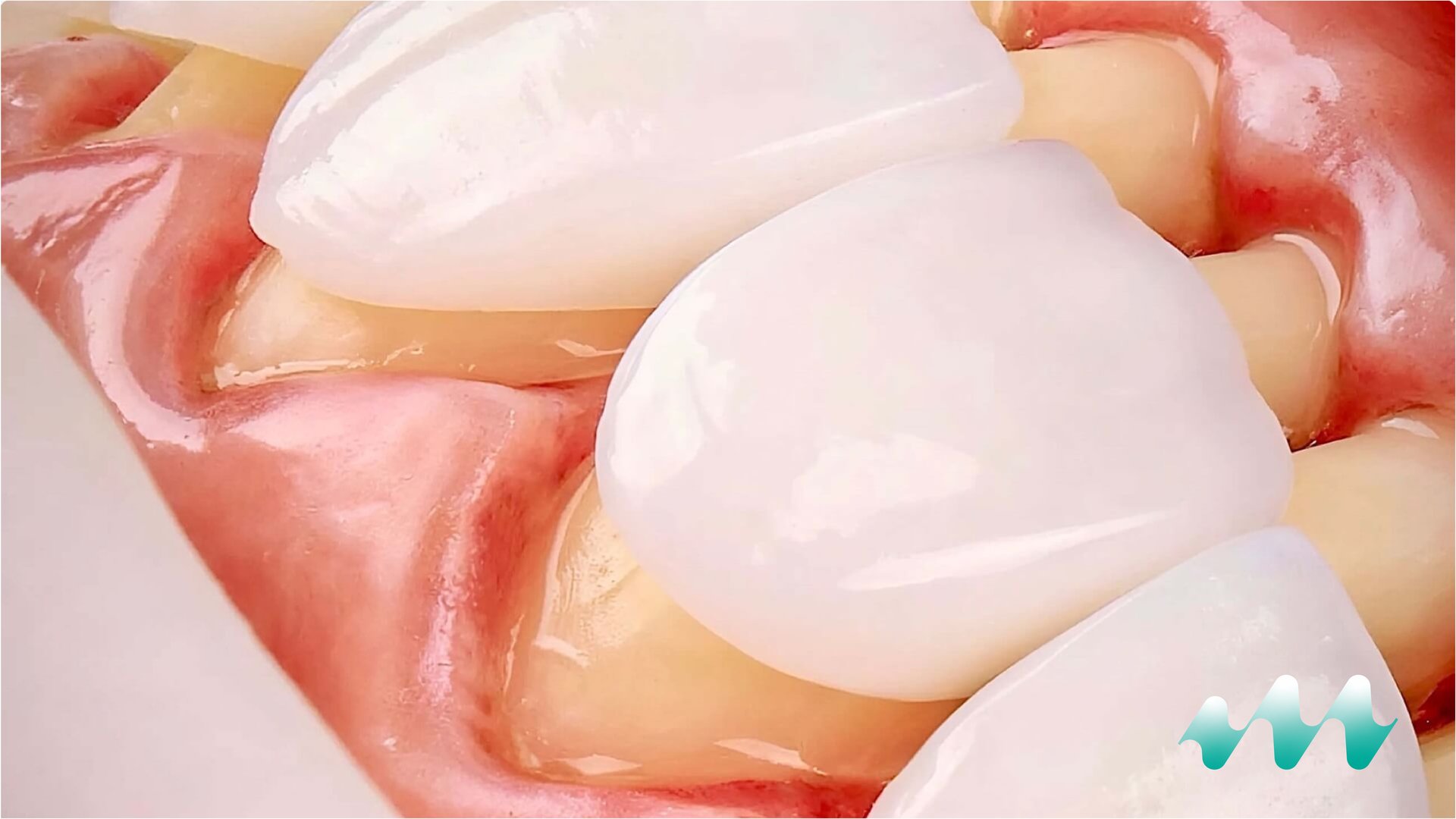
At Medicape Health, E-max dental treatment uses IPS e.max lithium disilicate glass-ceramic to rebuild, reshape and re-colour teeth with a light transmission that comes remarkably close to natural enamel. Because the material is strong enough to be used without any metal substructure or opaque core, E-max crowns and veneers are a frequent choice for front teeth, single-tooth restorations and complete smile makeovers where appearance is the priority.
E-max is not a technique on its own, it is a ceramic material. IPS e.max is a lithium disilicate glass-ceramic in which fine crystals are grown inside a glass matrix. The crystals carry the load and give the restoration its strength, while the surrounding glass phase lets light pass through and creates depth of colour. The same material can be produced in several forms:
Full-coverage E-max crowns for damaged, worn or root canal treated teeth
Thin E-max veneers bonded to the front surface of the tooth
Inlays and onlays that rebuild a chewing surface without covering the whole tooth
Short anterior bridges in carefully selected cases
This is why patients often ask whether they should choose "E-max or laminate". A laminate describes the form of the restoration, while E-max describes the material it is made from. Many of the veneers explained on our laminate dental treatment page are in fact produced from lithium disilicate.
How IPS e.max Is Produced: Press or CAD/CAM
There are two accepted production routes, and your dentist selects one according to the case rather than a fixed rule:
Press technique (IPS e.max Press): the restoration is first modelled in wax, then a pre-crystallised ceramic ingot is heat-pressed into the mould. This route gives the technician a high degree of control over very thin veneers and detailed anatomy.
CAD/CAM technique (IPS e.max CAD): the prepared tooth is scanned digitally, the restoration is designed on screen and milled from a partially crystallised block. The milled piece is then fired in a furnace, where it reaches its final crystal structure, shade and strength.
Both routes end with the same class of material. Press is often preferred for multi-unit aesthetic work and ultra-thin veneers, while CAD/CAM shortens laboratory time and suits single crowns, inlays and onlays.
Strength and Light Transmission
Lithium disilicate sits deliberately between conventional feldspathic porcelain and zirconia. Depending on the version and the laboratory protocol, its flexural strength is generally reported in the region of 400 to 500 MPa. What it offers in exchange for not being the strongest option is optical behaviour: it transmits and scatters light in a way opaque materials cannot reproduce, so the restoration picks up colour from the neighbouring teeth instead of standing out as a flat block of white. The material is also supplied in several translucency levels, so a more opaque ingot can be selected when a darker underlying tooth needs masking.
Who Is a Good Candidate for E-max?
E-max treatment may suit you if you have:
Discoloured front teeth that no longer respond to whitening
Chipped, worn or slightly irregular incisors
Small gaps between the front teeth
Old composite fillings or ageing crowns with a visible grey line at the gum
A single front tooth that must blend invisibly with its neighbours
A sensitivity or preference against metal-containing restorations
It is less suitable for untreated heavy bruxism, long-span bridges at the back of the mouth, or teeth with too little enamel for reliable adhesive bonding. In those cases your dentist may recommend zirconium crowns instead, or a combination of both materials in one plan.
E-max, Zirconium and Laminate Veneers Compared
Choosing between materials is a clinical decision, not a ranking. The table below summarises where each one is normally used.
Comparison Criteria
E-max (Lithium Disilicate)
Zirconium (Zirconia)
Porcelain Laminate
Material family
Glass-ceramic reinforced with lithium disilicate crystals
Polycrystalline ceramic based on zirconium dioxide
Feldspathic or leucite-reinforced porcelain, often also lithium disilicate
Relative strength
Medium to high, roughly 400 to 500 MPa
Highest of the three
Lowest, gains strength from the bond to enamel
Light transmission
Very close to natural enamel
Good in modern multi-layer versions, still more opaque
Excellent, thanks to minimal thickness
Usual indication
Front teeth, single crowns, veneers, inlays and onlays
Molars, bridges, implant-supported restorations, full-arch work
Purely aesthetic corrections on visible front teeth
Tooth preparation
Conservative, thin veneer designs are possible
More reduction is required for full coverage
Minimal, mostly limited to the enamel layer
Masking a dark tooth
Possible with a more opaque ingot
Very effective
Limited
Fixation
Adhesive bonding after etching and silane treatment
Adhesive or conventional cementation
Adhesive bonding only
In many Hollywood smile design plans the two materials are combined: lithium disilicate for the visible front teeth, zirconia for the load-bearing back teeth.
How the Procedure Works
Consultation and digital records: clinical examination, photographs, intraoral scan and, where needed, radiographs. Shade and tooth proportions are planned together with you.
Smile design and mock-up: the planned shape can be tested in your mouth as a temporary trial before any irreversible step is taken.
Preparation: the tooth is reduced conservatively, only as much as the chosen design requires.
Temporaries: provisional restorations protect the teeth and let you preview the result.
Laboratory stage: the restorations are pressed or milled, layered or stained, glazed and polished.
Try-in: fit, contact points, shade and the way the restorations follow your lip line are checked before cementation.
Adhesive bonding: the ceramic surface is etched and silanised, then bonded to the tooth with a light-cured resin cement.
Bite adjustment and polishing: the occlusion is refined and the surfaces are finished.
Aftercare and Longevity
Most patients return to normal eating within a day, and brief temperature sensitivity in the first week is common. Lithium disilicate does not absorb stain the way composite does, but the natural teeth and the bonding margins around it still do, so brushing twice daily, cleaning between the teeth and regular check-ups matter. A night guard is advised for patients who clench or grind. Published follow-up studies report high survival rates for single lithium disilicate restorations at ten years, and ten to fifteen years or longer is realistic with good oral hygiene, although individual outcomes vary.
E-max Dental Treatment in Turkey
Turkey has become a leading destination for ceramic dental work, and our patients travel to Adana for treatment coordinated by Medicape Health. Your assessment can begin remotely with photographs and existing radiographs, so the plan and the number of visits are known before you fly.
A typical E-max plan is completed in two clinical stages within roughly five to seven days: preparation, scanning and temporaries at the beginning of the stay, then try-in and bonding at the end, with the laboratory work carried out in between. More extensive cases, or cases that require gum treatment or endodontics first, may need a longer stay or a second visit.
Patients choose Turkey for E-max treatment because of:
Experienced prosthodontists and cosmetic dentists
Digital scanning, smile design software and modern dental laboratories
Original, brand-certified ceramic materials
Short scheduling times and treatment completed in a single trip
Full medical travel support including transfers, accommodation and translation
E-max Cost in Turkey
E-max treatment in Turkey is generally more accessible than in Western Europe or the United Kingdom, but the figure is always case specific. We do not publish fixed prices, because these factors change every plan:
The number of teeth to be restored
Whether crowns, veneers, inlays or a combination are planned
The production route selected, press or CAD/CAM
Any preparatory treatment such as fillings, gum therapy or root canal work
Whether whitening of the remaining teeth is included
You will receive a written, itemised plan after your assessment, so you know what is included before you travel.
Why Choose Medicape Health?
Prosthetic treatment planned and carried out by Dr. Dt. Başak Tükel, Prosthetic Dentistry Specialist with more than 13 years of clinical experience in Adana
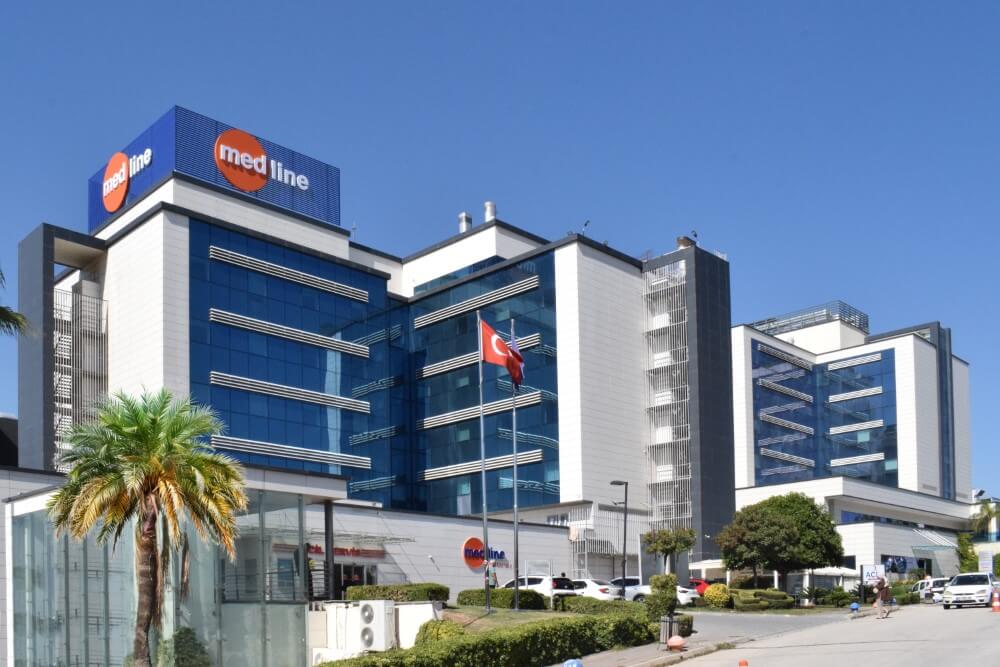
Care coordinated in Adana, with our contracted hospital Private Medline Adana Hospital available when a case requires hospital facilities
Digital scanning, smile design and shade analysis before any preparation
Original IPS e.max materials, with documentation provided
A written treatment plan and no pressure to accept more restorations than your case needs
Interpretation, transfers and follow-up support for international patients
You can review the full range of options on our dental treatments page, or contact us for an assessment of your own case.
What exactly is IPS e.max made of?
It is a lithium disilicate glass-ceramic. Crystals grown inside a glass matrix provide the strength, while the glass phase gives the restoration its enamel-like light transmission. It contains no metal.
Is E-max stronger than zirconium?
No. Zirconia has the higher flexural strength of the two. Lithium disilicate is chosen when appearance is the priority and the load is moderate, which is why the two materials are often used together in the same mouth.
How long do E-max crowns and veneers last?
Follow-up studies report high survival rates for single restorations at ten years, and ten to fifteen years or longer is realistic with good oral hygiene. No restoration can be guaranteed for a fixed period.
Can E-max be used on molars?
It can be used for single crowns, inlays and onlays on back teeth in suitable cases. For long bridges, heavy grinding or very high chewing loads, zirconia is usually the safer choice.
Is E-max the same thing as a laminate veneer?
Not quite. Laminate describes a thin veneer bonded to the front of the tooth, while E-max is the material it can be made from. Laminates may also be produced from other porcelains.
How much tooth structure is removed?
Less than for a conventional crown. A veneer design is largely confined to the enamel, while a full E-max crown needs more reduction. The exact amount depends on the tooth and the design chosen.
Can E-max crowns be placed on implants?
It can be used on implants in selected single-tooth situations, but zirconia is more commonly preferred for implant-supported work because of the loads involved.
How many days do I need to stay in Turkey?
Most E-max plans are completed in about five to seven days across two clinical stages. Cases that need preparatory treatment first may require a longer stay or a second visit.
Dr. Dt. Başak Tükel Prosthetic Dentistry Specialist
Safe Clinical Environment Contracted Medical Facilities
Metal-Free Aesthetic Restorations Lithium Disilicate Crowns and Veneers
E-max plans at Medicape Health are prepared by a prosthetic dentistry specialist who works with lithium disilicate on a daily basis. Shade, tooth proportions and the gum line are assessed together with you before any preparation is carried out.
Treatment is delivered in contracted, fully equipped clinical facilities in Adana that follow international hygiene and sterilisation protocols, with the same standards applied to local and international patients.
Each restoration is produced from IPS e.max ingots or blocks in a partner laboratory, so thickness, translucency and surface texture are matched to the natural teeth surrounding the restoration.
Whether you are restoring a single discoloured front tooth or planning a complete aesthetic rehabilitation of the upper arch, your E-max treatment in Turkey is built around your own enamel colour, lip line and facial proportions rather than a standard shade chart.
E-max Dental Treatment in Turkey
E-max is the commercial name of IPS e.max, a lithium disilicate glass-ceramic that has become one of the most requested materials among patients travelling to Turkey for aesthetic dentistry. The reason is optical: it is entirely metal-free and transmits light in a way that stays close to natural enamel, so a single crown or veneer can sit beside untouched teeth without drawing attention to itself.
Turkish clinics adopted intraoral scanning, CAD/CAM milling and press ceramics early, and the dental laboratories serving them handle international aesthetic cases week after week. That volume matters with lithium disilicate, because the distance between an acceptable restoration and an invisible one depends largely on how experienced the ceramist is with translucency levels, staining and surface texture.
E-max dental treatment in Turkey can provide:
Metal-free crowns and veneers with enamel-like light transmission
Conservative tooth preparation compared with metal-supported crowns
Shade planning carried out against your remaining natural teeth
Solutions for single front teeth, inlays, onlays or a full aesthetic plan
Digital design with a mock-up you can preview and adjust
A treatment sequence that usually fits into one short stay
Considering E-max Dental Treatment?
Tell us briefly about your case and our patient coordinator will get back to you with the details.
Turkey has become a leading destination for lithium disilicate restorations thanks to a combination of experienced aesthetic dentists, in-house or closely connected dental laboratories and accessible pricing. Cases that would be split across several appointments over many weeks elsewhere are frequently organised into a compact schedule here.
Key advantages of choosing Turkey for E-max treatment include:
Dentists and ceramists with a high case volume in anterior aesthetic restorations
Access to both production routes, pressed IPS e.max and milled IPS e.max CAD
Digital scanning and smile design used as standard rather than as an extra
Accredited clinical facilities working to international safety standards
Short laboratory turnaround, since the technician and the dentist work closely together
Dedicated coordination for international patients, including transfers and accommodation
The practical result is that material choice stays a clinical decision: where a tooth needs more strength than lithium disilicate offers, zirconia can be used for that position while E-max stays where light transmission matters most.
Medicape Health × Medline Adana Hospital
OUR TRUSTED HOSPITAL PARTNER
A Partnership Backed by International Trust
Medicape Health works in partnership with Medline Adana Hospital, a long-standing healthcare provider for the international community, including U.S. personnel associated with İncirlik Air Base.
A Relationship Recognized Since 2015
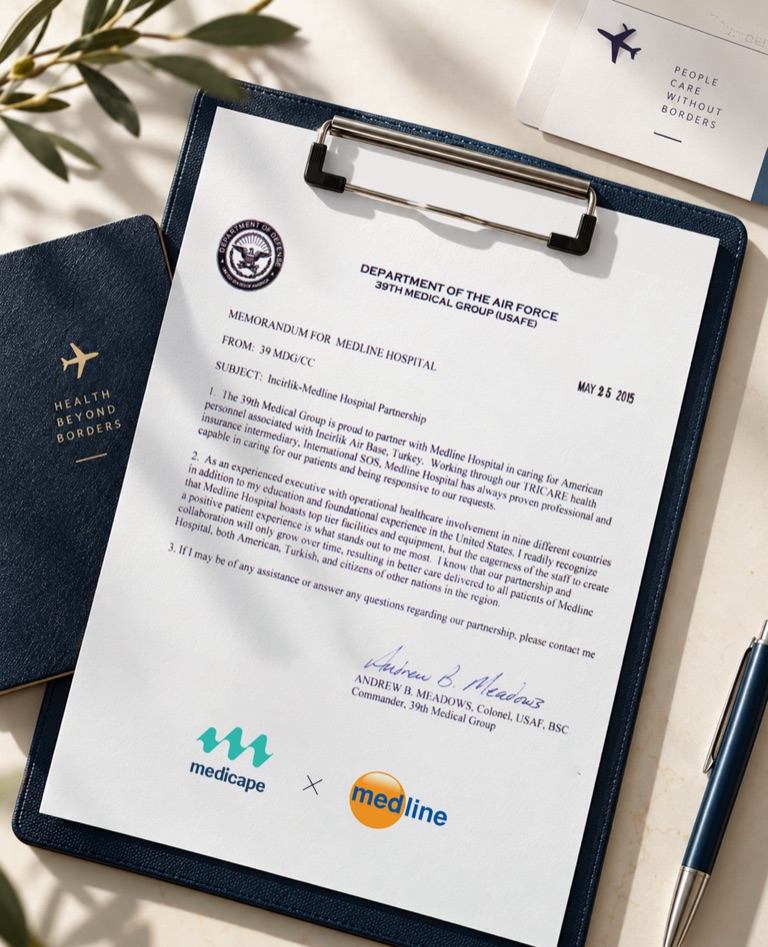
Medline Hospital’s quality of care and patient experience were recognized by the Commander of the U.S. Air Force 39th Medical Group in 2015.
E-max treatment in Turkey is generally more accessible than comparable aesthetic dentistry in Western Europe, and this is achieved without changing the ceramic system itself. What moves the figure is the scope of the plan rather than the destination.
Factors that influence E-max dental treatment price include:
The number of teeth involved and whether crowns, veneers, inlays or onlays are planned
The production route selected for the case, pressed or milled
The translucency level required, since masking a darkened or root canal treated tooth calls for a more opaque ingot
Preparatory work such as gum treatment, whitening of the remaining teeth or removal of old restorations
The standard of the laboratory and the experience of the dentist and ceramist
Whether the plan combines lithium disilicate at the front with zirconia at the back
Because no two smiles need the same combination of restorations, the exact figure is confirmed after a clinical examination, a digital scan and a shade analysis rather than quoted from a fixed list.
E-max Dental Treatment: Turkey vs UK
Comparison Criteria
Turkey
United Kingdom
Dentist Expertise
Prosthetic dentistry specialists with a high volume of anterior lithium disilicate cases
Certified cosmetic dentists with widely varying case numbers
Technology & Digital Planning
Intraoral scanning, CAD/CAM milling and press ceramics available in the same plan
Digital workflow available depending on the practice
Waiting Time
Appointments arranged quickly, with laboratory stages scheduled around your stay
Longer waiting periods spread over several separate appointments
Treatment Packages
Consultation, mock-up, restorations and follow-up organised as one package
Item-by-item pricing with laboratory and review fees added separately
Materials Used
Original IPS e.max ingots and blocks, with zirconia available where strength is needed
High-quality materials that vary from provider to provider
Customization Level
Shade, translucency and tooth proportions planned individually with a trial mock-up
Standard aesthetic planning in most cases
International Patient Experience
Extensive experience with patients travelling for aesthetic dentistry
Primarily oriented towards domestic patients
Privacy & Comfort
Discreet scheduling with full medical travel support
At Medicape Health, Hollywood Smile Design is a comprehensive smile transformation tailored to your unique facial features, tooth structure, and aesthetic goals. Combining premium porcelain veneers, zirconium crowns, teeth whitening, and gum contouri...
At Medicape Health, Zirconium Dental Treatment offers a durable, aesthetic, and biocompatible solution for restoring damaged, discolored, or misshapen teeth. Zirconium crowns combine exceptional strength with natural transparency, providing long-last...
At Medicape Health, Laminate Dental Treatment offers a minimally invasive and highly aesthetic solution for creating a flawless smile. Using ultra-thin porcelain veneers, laminates enhance the color, shape, and alignment of the teeth while preserving...
 English


 Turkey
  United Kingdom