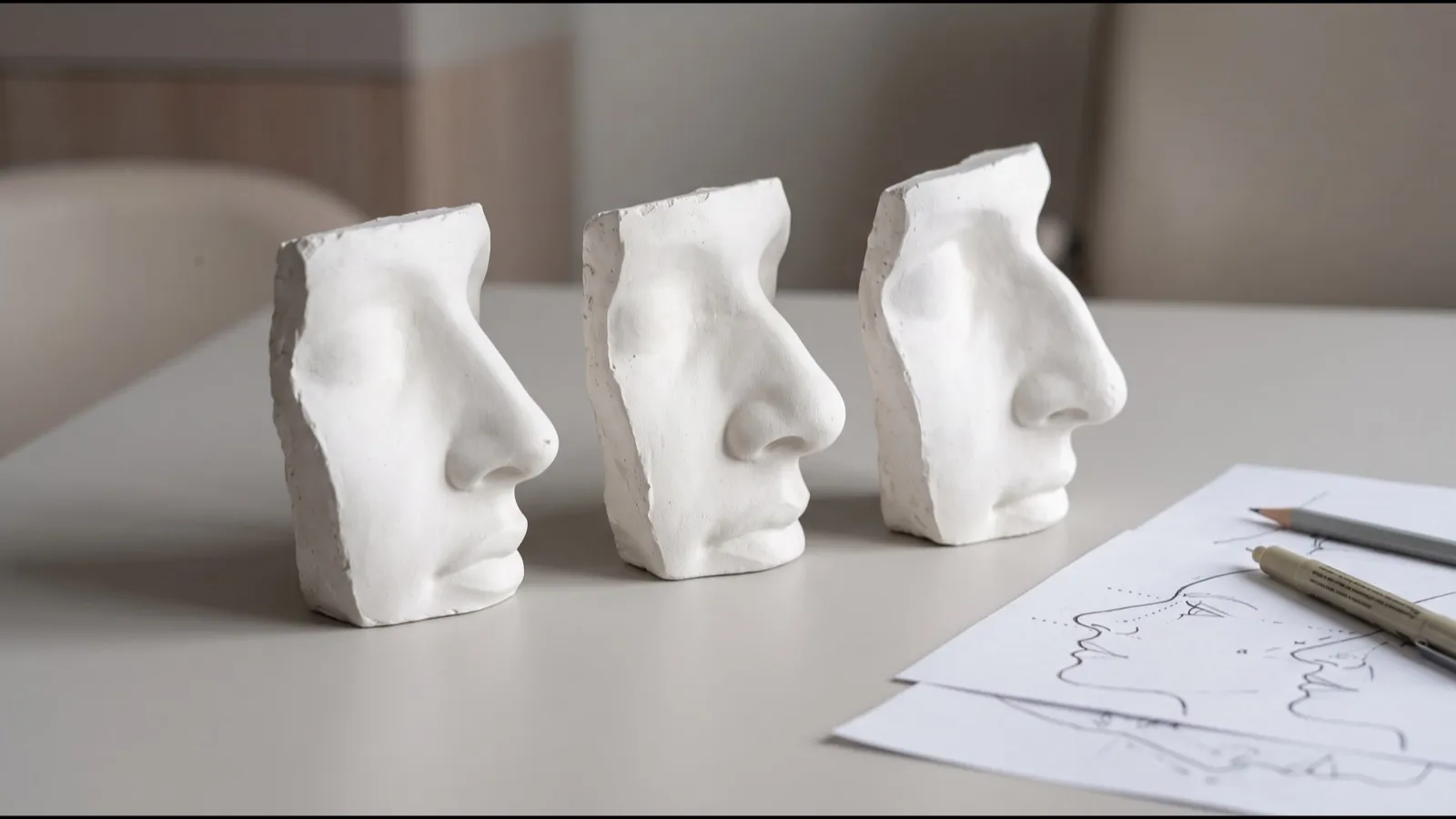
Many people who search for ethnic rhinoplasty have the same worry. They want a nose that breathes well and sits in better balance with the rest of the face, but they do not want to come home with a nose that looks borrowed. They want to look like themselves, and like their family, only more at ease with their profile. This article explains what ethnic rhinoplasty means in practice, which features surgeons usually change, which they work hard to keep, and how to tell whether a plan respects your face.
There is no separate operation called ethnic rhinoplasty. The term describes an approach: rhinoplasty planned around the nasal anatomy and facial proportions that are common in a particular background, rather than around a single "standard" nose. Middle Eastern, African, Asian, Mediterranean and Latin American noses tend to differ in skin thickness, cartilage strength, bridge height and nostril shape. A technique that works well on thin skin and strong cartilage can give a poor result on thick skin and soft cartilage.
So the word "ethnic" is less about identity and more about tissue. It tells the surgeon to start from your anatomy, not from a template. You can read how we approach the procedure on our ethnic rhinoplasty page.
The goals of most patients are surprisingly similar, whatever their background. The changes requested most often are:
Not every patient needs all of these. A good plan picks the one or two changes that make the biggest difference and leaves the rest alone.
The features that make a face recognisable are rarely the ones a patient complains about. Skin colour and texture, the width between the eyes, the shape of the lips and cheeks all stay the same after rhinoplasty, so the nose must still belong to that face. In practice, surgeons try to preserve:
If a simulation or a description of your result sounds like someone else's nose, say so before surgery. That conversation is much easier than a second operation. Our article on revision rhinoplasty and when to wait explains why.
The table below shows how common anatomical features change the surgeon's approach. It is a general guide; your own nose may combine several of these.
| Feature | What it means for surgery | Typical approach |
|---|---|---|
| Thick skin | Fine detail shows less; swelling lasts longer | Build a stronger tip framework instead of removing more cartilage |
| Thin skin | Every irregularity can show | Smooth edges carefully; sometimes soft tissue camouflage |
| Soft tip cartilage | Tip may lose shape as swelling settles | Support grafts, usually from septal cartilage |
| Low bridge | Eyes and nose can look disconnected | Modest augmentation with the patient's own cartilage |
| Prominent hump | Profile looks heavy | Controlled reduction, keeping a natural line |
| Wide nostril base | Lower nose looks broad from the front | Small nostril reduction hidden in the crease |
Many patients only mention breathing when asked. Yet a narrowed airway, a crooked septum or swollen turbinates can be the reason the nose looks the way it does, and they can be made worse by an operation that only considers shape. A combined approach, in which the inside of the nose is assessed as carefully as the outside, protects both function and appearance.
At Medicape, nasal surgery is planned by Dr. Sümbül Bayraktar Güzeldağ, an ear, nose and throat surgeon, so the airway is part of the assessment from the first consultation. For a broader overview of the operation itself, see our rhinoplasty page.
Recovery after ethnic rhinoplasty follows the same early pattern as any rhinoplasty: a splint for the first days, bruising that fades over a couple of weeks, and a nose that looks presentable long before it looks final. The difference is the last stage. Thick skin holds swelling, especially around the tip, so the final shape appears gradually over many months. Patients who know this in advance are far less anxious at their check-ups.
If you are travelling for surgery, our guide to rhinoplasty recovery for international patients covers flights, follow-up and what to plan before you book.
It should not. The aim is a nose that suits your own face. A plan that copies a single "ideal" nose without regard to your features is a reason to ask more questions or seek another opinion.
The operation uses the same techniques. What differs is the plan: skin thickness, cartilage strength and facial proportions decide how much is changed and how the new shape is supported.
Often, yes. Many surgeons prefer the patient's own cartilage, usually from the septum and sometimes from the ear or a rib, because it integrates with the tissue. Your surgeon will explain which option suits your anatomy.
Yes. A deviated septum or enlarged turbinates can usually be corrected at the same time as the cosmetic changes, which is one reason a thorough examination of the inside of the nose matters.
 English


