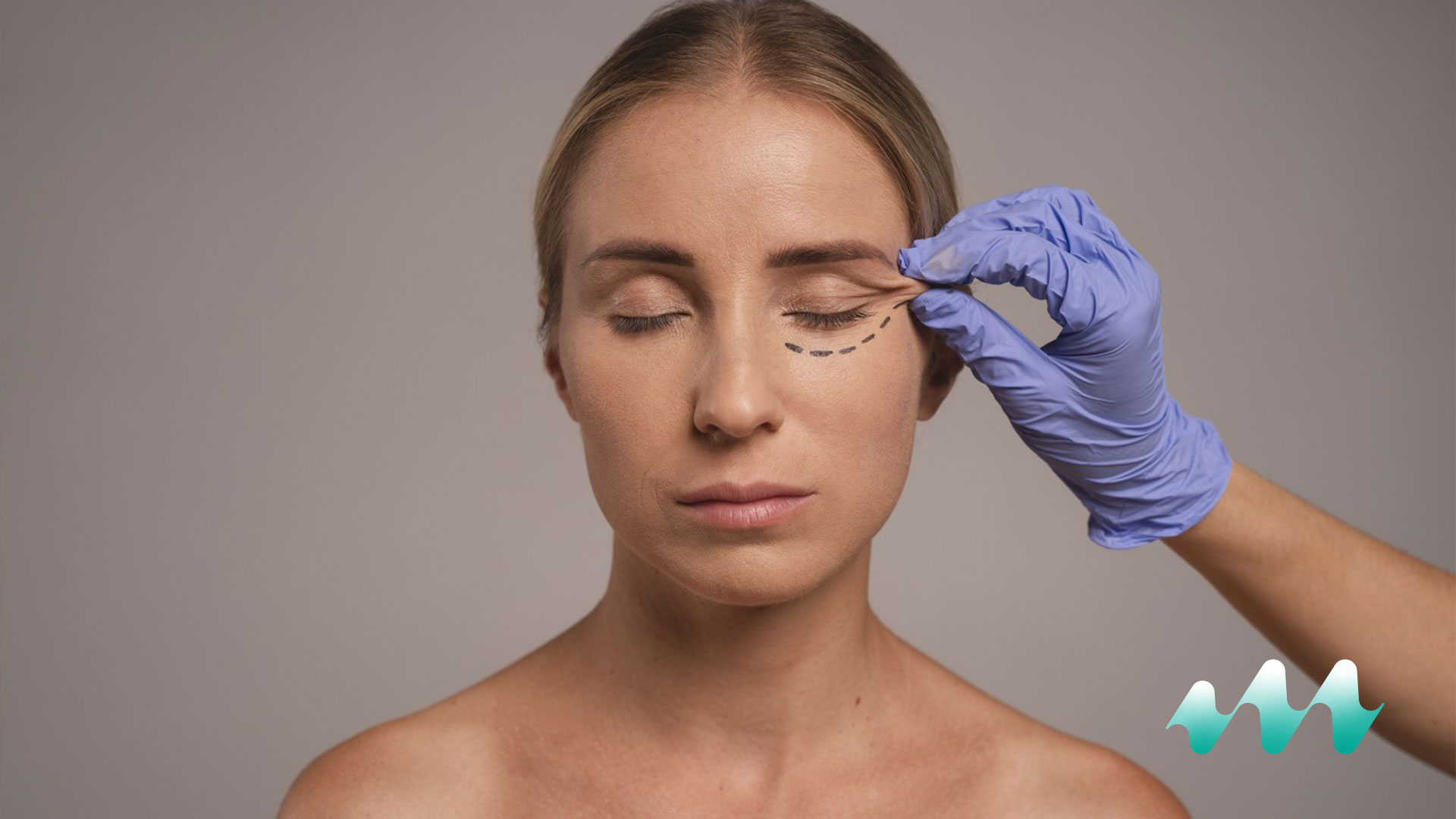
"Do I need a temple lift or a brow lift?" is one of the most common questions we hear from patients in their thirties to fifties who feel that their eyes look tired even after a good night's sleep. The two operations sound similar and both lift the eyebrow, but they treat different problems, involve different incisions and recover at different speeds. This guide explains how surgeons decide between them, so that you arrive at your consultation knowing what to ask.
The eyebrow does not age evenly. In most people the outer third, the "tail" of the brow, descends first, because the tissues at the temple are thinner and less supported than the forehead. As it drops, it pushes skin down onto the outer upper eyelid, and the eye starts to look hooded and heavy at the corner. The middle of the forehead may still be perfectly smooth.
A temple lift, also called a temporal lift or lateral brow lift, corrects exactly this pattern. Through a short incision hidden in the hair above the temple, the surgeon releases and re-suspends the outer brow and the temple skin. Nothing else on the forehead is touched.
A full brow lift, also called a forehead lift, repositions the entire eyebrow from the inner corner to the tail and treats the forehead itself: horizontal lines, the vertical frown lines between the brows, and a brow that sits low across its whole length. It is performed either through several small endoscopic ports across the scalp or, less often today, through a longer incision along the hairline.
At examination, three things are assessed. First, where the brow sits relative to the bony rim above the eye: if only the outer part has dropped below the rim, a temple lift is enough; if the whole brow sits below it, a full lift is needed. Second, how much upper-eyelid skin is excess, because a heavy lid is often caused partly by the brow and partly by the lid itself, and the two may need treating together. Third, forehead muscle activity: patients who constantly raise their eyebrows to open their eyes have usually adapted to a low brow across its whole width, which points towards a full brow lift.
A simple test you can do at home: look in a mirror with a relaxed forehead and gently lift only the tail of your eyebrow with a fingertip. If that alone makes the eye look open and rested, you are describing a temple lift. If you have to lift the whole brow to get the effect, or the forehead lines are what bother you, the conversation should be about a brow lift.
| Temple lift | Full brow lift | |
| Incision | One short incision per side, inside the temporal hairline | Several endoscopic ports across the scalp, or a longer hairline incision |
| Anaesthesia | Local with sedation in most cases | General |
| Operation time | About 45 to 60 minutes | About 1.5 to 2 hours |
| Swelling and bruising | Mild, mostly at the temples, settles in about a week | More pronounced across the forehead and around the eyes, 10 to 14 days |
| Numbness of the scalp | Rare and limited | Common for several weeks, occasionally longer |
| Back to desk work | 3 to 5 days | 7 to 10 days |
| Effect on forehead lines | None | Softens horizontal lines; frown muscles can be weakened at the same time |
A large group of patients falls between the two: the outer brow has dropped, and there is also loose skin on the upper eyelid. For them, the most natural result usually comes from combining a temple lift with upper eyelid surgery in the same session, rather than from a full brow lift. The temple lift restores the distance between the brow and the lashes; the eyelid surgery removes the skin that the brow was not responsible for. Doing only one of the two often leaves the eye looking either small or still heavy.
Patients whose concern extends to the cheeks and jawline are sometimes offered a temple lift together with a mini facelift. Again, the full brow lift is reserved for cases where the forehead itself is the problem.
Botulinum toxin placed at the outer brow can give a modest lift of a millimetre or two by relaxing the muscle that pulls the brow down. It suits patients with very early changes, lasts three to four months, and does not remove or reposition tissue. Thread lifts of the temple give a temporary result that typically fades within a year. Neither replaces a temple lift once the brow has genuinely descended, but both are reasonable ways to test whether you like the look of a raised outer brow before committing to surgery.
Both operations are performed at Medicape Health by Prof. Dr. Cengiz Eser, a professor of plastic, reconstructive and aesthetic surgery, at the contracted hospital in Adana. For a temple lift, most international patients stay five to seven days, which covers the operation, a check-up and suture removal before flying home. A full brow lift, or a combined procedure, usually means a stay of seven to ten days. A consultation over video with your photographs is enough for the surgeon to tell you which operation he would recommend and why.
For a detailed description of the procedure itself, candidates and recovery, see the temple lift treatment page.
 English


